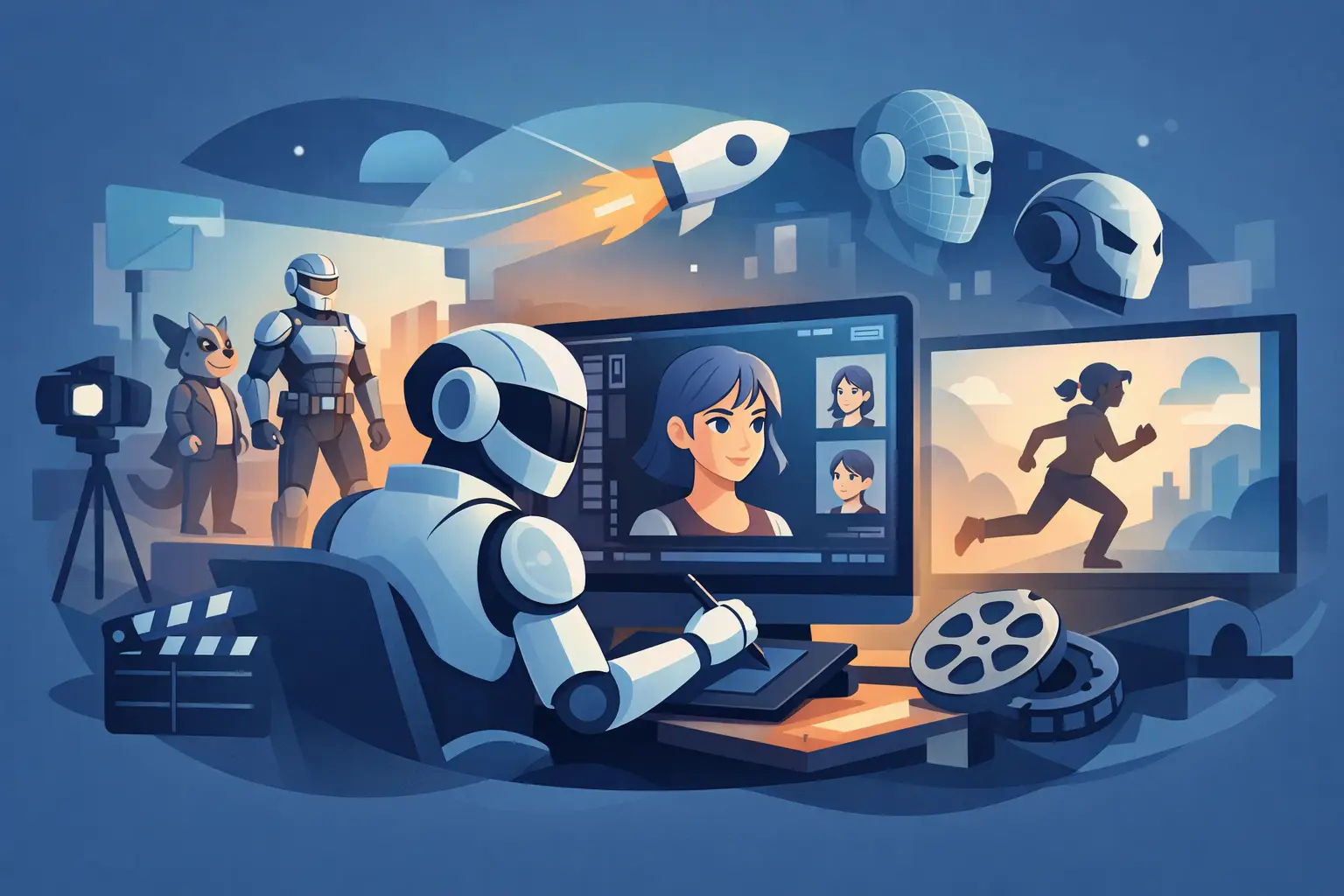
A script is finished, the pitch meeting is coming, and everyone has a different picture of the lead in their head. That gap is where character design AI for movies becomes useful. Not as a replacement for costume designers, concept artists, or directors, but as a fast visual development layer that helps teams align before time and budget start slipping.
For filmmakers, speed only matters if it improves decisions. A character concept that looks impressive but ignores tone, era, casting realities, or production constraints creates more work, not less. The value of AI in character design is its ability to turn screenplay information into early visual options quickly enough to support development, packaging, and pre-production when timing matters.
What character design AI for movies actually does
At its best, character design AI for movies translates written character information into visual starting points. That includes age range, wardrobe cues, physical presence, emotional tone, genre fit, and world consistency. Instead of waiting days or weeks for first-pass concept exploration, filmmakers can generate multiple directions early and pressure-test how a character reads on screen.
This is especially useful when the script carries strong descriptive signals but the team has not yet converted them into a visual language. A crime thriller, a contained sci-fi film, and a grounded family drama all ask different things from character design. AI can help surface those differences fast, making abstract conversations more concrete.
The key phrase here is starting points. Good teams use AI-generated character concepts to sharpen conversations, not to end them. A generated image can reveal whether the character feels too generic, too stylized, too expensive to execute, or too far from the script's emotional center. That kind of feedback is valuable because it happens early, when change is cheaper.
Why filmmakers are using it now
Traditional character concepting can be slow for reasons that make sense. You are balancing story intent, practical production needs, department collaboration, and sometimes investor or distributor expectations. But independent producers and fast-moving development teams do not always have the luxury of a long concept phase.
That is where AI becomes practical. It can compress the first round of visual exploration from weeks into hours. For a filmmaker preparing a deck, refining a pitch, or evaluating whether a script's characters feel distinct enough to carry a film, that speed creates leverage.
There is also a workflow advantage. Character design does not live in isolation. It affects storyboards, poster concepts, tone references, casting conversations, wardrobe planning, and even budget assumptions. If the visual direction of a character shifts from minimalist realism to heightened genre styling, that choice ripples outward. Faster character exploration leads to faster clarity across the rest of pre-production.
Where AI helps most in the movie pipeline
Early development is the clearest win. When a screenplay is fresh, teams need visual references that make the project easier to evaluate and easier to communicate. Character images can help a producer decide whether the world feels premium enough for market positioning, whether the protagonist reads with enough specificity, or whether supporting roles are too visually interchangeable.
Pitch packaging is another strong use case. Investors, partners, and internal stakeholders often respond better to character direction they can see. A script can describe a protagonist as sharp, exhausted, quietly dangerous, and emotionally inaccessible. An image that captures that mix gives the room something to react to immediately.
Pre-production planning is where the practical value becomes even clearer. Once the team starts thinking about casting fit, wardrobe tone, hair and makeup approach, and visual cohesion across the ensemble, AI-assisted concepts can shorten the distance between script and department planning. They do not replace department heads. They give them a faster launch point.
The real strengths of character design AI for movies
The first strength is volume without paralysis. A strong system can produce multiple character directions from the same script data, helping teams compare grounded versus stylized looks, period-accurate versus slightly heightened design, or commercial versus auteur-leaning presentation. That range is useful because many scripts can support more than one viable visual interpretation.
The second strength is consistency. If the tool is working from screenplay analysis instead of disconnected prompts, character concepts are more likely to align with tone, world, and role function. That matters in film. A compelling standalone portrait is not enough if it looks like it belongs in a different movie.
The third strength is efficiency. Fast concept generation supports real production needs: deck building, internal approvals, buyer conversations, and downstream visual planning. For small teams especially, reducing handoff delays can materially change how fast a project moves.
Where it can go wrong
AI-generated character design becomes a problem when it is treated as finished creative instead of informed iteration. Many outputs look polished at a glance and shallow on inspection. They may over-index on genre clichés, flatten ethnic or cultural specificity, or produce costume ideas that look expensive but impossible for the actual budget.
There is also the issue of sameness. If a team relies on generic prompting or does not anchor the tool in screenplay-specific inputs, characters can start to feel interchangeable with every other AI-assisted project. That is a serious risk in a market where distinctiveness is part of the pitch.
Then there is production reality. A concept image might suggest fabric choices, silhouettes, props, or environments that work beautifully in an image and badly on a shooting schedule. Good visual development always has to answer a practical question: can this be built, sourced, worn, and shot at the level the film can afford?
How to evaluate AI character outputs like a producer
The first test is story fit. Does the design feel like the person on the page, or just an attractive image in the genre? If the protagonist's tension comes from contradiction, the visual should carry some of that contradiction too.
The second test is ensemble contrast. Put the leads and key supporting characters side by side. Do they read as distinct social, emotional, and narrative functions within the same world? If not, the issue is not just visual. It may point to script clarity as well.
The third test is production viability. Ask what the design implies for wardrobe, hair and makeup, location tone, and casting range. A concept that forces expensive execution choices should be identified early, not after the team has emotionally committed to it.
The fourth test is market usefulness. If this character appears in a pitch deck, poster mockup, or first-pass storyboard, does it help sell the film you are actually making? Bold visuals can help, but only when they support positioning instead of distorting it.
What the best workflow looks like
The strongest approach starts with the screenplay, not random image prompts. Character design should come from breakdowns, tone analysis, role function, and world logic. That gives the visual output a narrative spine.
From there, speed matters. Teams should be able to review multiple directions quickly, reject weak paths, and refine promising ones without getting lost in endless experimentation. Fast iteration is only useful when it leads to stronger decisions.
Then comes integration. Character design should connect to storyboards, poster concepts, camera thinking, and packaging materials. This is where an all-in-one pre-production workflow becomes more valuable than isolated image generation. A character is not just a portrait. It is a production variable.
That is why platforms built around screenplay intelligence have an advantage. If visual outputs are tied to the actual script and connected to broader pre-production materials, the result is more actionable. FilmPilot.ai fits that model by treating character design as part of a larger development package rather than a standalone novelty.
Character design AI for movies is not about replacing artists
For serious filmmakers, that framing is too simplistic. The real question is whether AI helps creative teams get to better decisions faster. In many cases, it does. It reduces early ambiguity, gives stakeholders something concrete to respond to, and helps projects move from script to visual strategy without the usual lag between departments.
But it still depends on taste, oversight, and context. The best results happen when filmmakers know what problem they are solving. Are they trying to define tone, sharpen a pitch, test marketability, or prep for departmental planning? Different goals require different visual outputs.
Used well, AI does not flatten the creative process. It compresses the time between idea and evaluation. That matters in film because momentum is fragile. Projects often stall not because the script lacks promise, but because the supporting materials take too long to catch up.
If character design can help a team see the movie sooner, align faster, and plan with more precision, it is doing exactly what pre-production tools should do: removing friction so better creative choices can happen earlier.